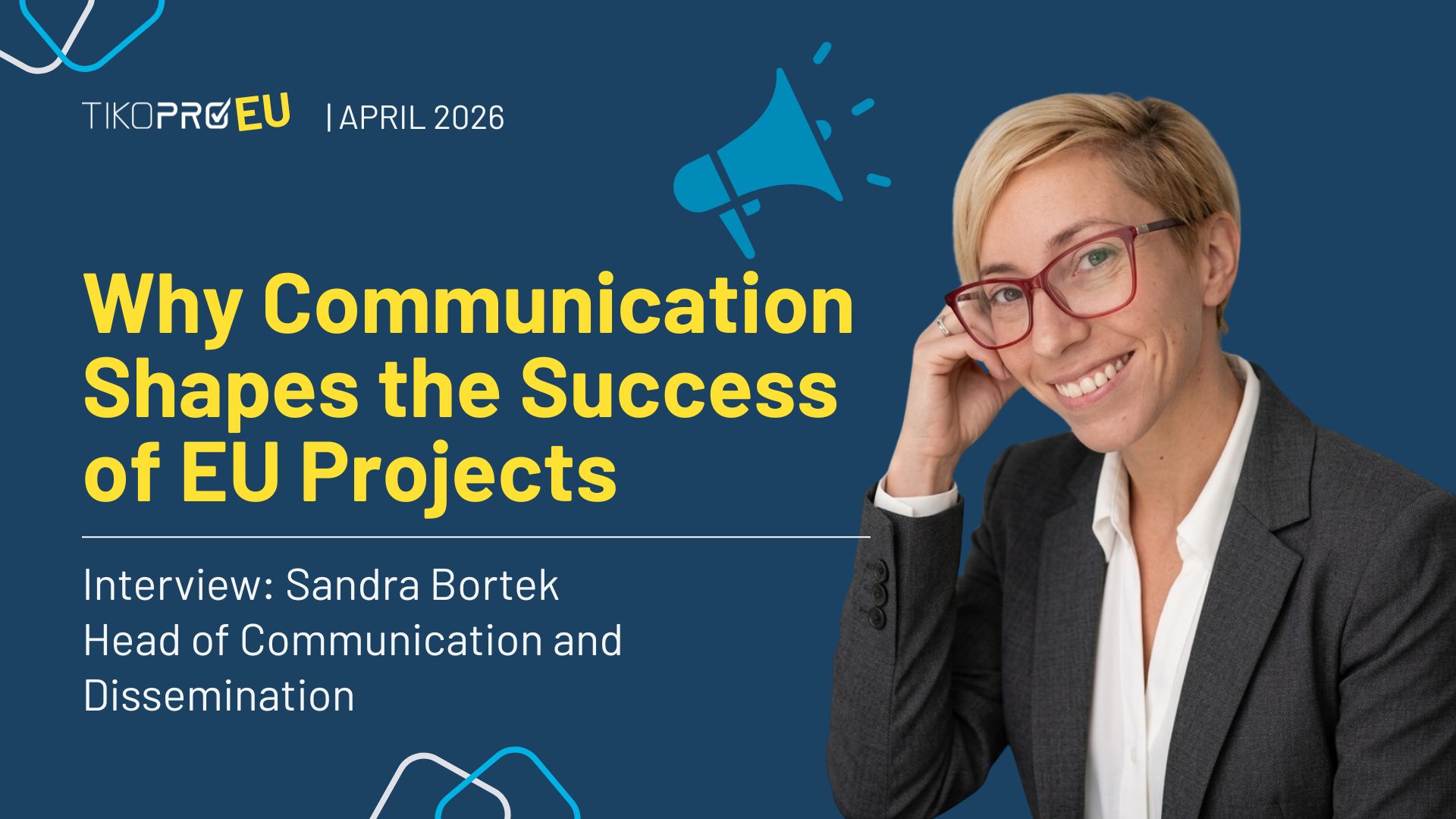
In this interview, Sandra Bortek, Head of Communication and Dissemination at Tiko Pro, shares her perspective on why strong results are often not enough - and what it actually takes for communication and dissemination to contribute to real impact.
In EU-funded projects, communication and dissemination are often treated as formal obligations - something to plan, report, and complete. In practice, they are what determines whether project results are understood, trusted, and used beyond the consortium.
When approached strategically, communication and dissemination go beyond visibility. They help translate complex project results into meaningful messages, connect them with the right stakeholders, and support engagement, learning, and long-term uptake.
In this edition, we speak with Sandra Bortek, Head of Communication and Dissemination at Tiko Pro, who leads these activities across multiple EU-funded projects. With 20 years of experience in strategic marketing and project development, she focuses on aligning project objectives with stakeholder needs and ensuring that communication efforts are grounded in real content, not abstract messaging.
In this interview, she shares her perspective on why strong results are often not enough and what it actually takes for communication and dissemination to contribute to real impact.
 Many EU projects deliver strong technical results, yet they struggle to achieve real-world impact. Where do you see the main gap?
The gap is not technical - it’s interpretational. Projects build solutions, but they don’t translate them into something stakeholders actually understand, trust, or see value in. They just don’t communicate that in the right way. There’s an assumption that if you build something good, people will adopt it. That’s not the way things work or happen. Impact starts when someone outside the consortium sees how that result fits into their reality. Most projects never get there. They stay inside the consortium, their own logic, their own language, their own assumptions. That’s where things break.
Communication and dissemination are often mentioned in EU projects, but what do these terms mean in practice?
The main difference lies in the focus of these activities. Communication is about visibility and understanding. It answers questions like what is this project, why does it matter, and who should pay attention? It helps position the project externally and ensures that people can follow what is happening. In most cases, it targets a broader audience and builds general awareness. Dissemination goes a step further and focuses on results. It answers questions such as what has been developed, what works, and how can others use it? It is about transferring knowledge in a way that is practical and usable, not just shared.
How are communication and dissemination activities connected to marketing, and where do they differ?
Communication and dissemination are closely connected, whether projects acknowledge it or not. At the core, communication and dissemination rely on the same principles as marketing. You need to understand your audience, shape messages, choose the right channels. If you remove that thinking, you end up with generic content that doesn’t resonate with anyone. That is why marketing background should be important if you wish to lead communication and dissemination activities on EU projects.
Where they differ is in intent and context. In marketing, you are usually promoting a product or service with a clear commercial goal. In EU projects, you are often working with early-stage results, collaborative outputs, or concepts that are still evolving. You also operate within a framework of transparency, neutrality, and accountability. That changes how you communicate. You’re not selling, but you still need to convince your target that you are making something valuable for them. You’re not positioning a product, but you are positioning value.
The mistake many projects make is trying to separate the two completely. When that happens, communication becomes descriptive instead of meaningful. The real challenge is applying marketing logic without turning the project into a sales pitch so that what is developed can connect with the people it is intended for.
In your experience, what are the most common mistakes consortia make when it comes to communication and dissemination?
I can outline a couple of things that I saw. First, they start too late. Communication is treated as something that follows development, instead of shaping it. Second, they stay generic. The messaging tries to cover everything, so it ends up meaning very little to anyone. And the third, they measure activity instead of impact. Number of posts, number of events, but no real understanding of whether anything changed for the target audience. These mistakes are common, and they’re also avoidable, but only if communication is taken seriously from the start.
That`s why when we participate in project, we do track the KPIs that are set, but behind all activities we go deeper into activities and compare what works and what doesn’t. Based on statistics we change or update the CD Plans and strategies to be more aligned with the community response.
Tiko Pro is involved in several complex EU projects. What makes communication in these environments particularly challenging, and what have you learned from it?
The complexity is not just technical, it’s organisational. You’re dealing with multiple partners, different levels of maturity, different expectations, and often very different ways of thinking. The challenge is turning that into a coherent narrative. At this moment we are a lead for communication, dissemination and stakeholder engagement on four EU project: ALiEnS-SOC, INTERCEPT, CRACoWi and DETANGLE. Last year we have successfully closed the UNDERPIN project.
What we’ve learned is that communication in these environments is less about creating content and more about creating alignment. If partners don’t share a common understanding of what they’re building and why it matters, that confusion will show externally. So, a big part of our work happens internally, before anything is published.
We have a remarkable marketing team that takes the challenges of each project. We take our contributions seriously, but this is something you can always expect from someone that understands marketing on different levels and has knowledge in different area. We discuss, we share ideas, we try to upgrade everything we have already done or tested and then include it in the project. With every new project, we as a team also grow.
Looking at the projects you work on now, which projects would you highlight as strong examples of effective communication and dissemination, and why?
I would definitely highlight the UNDERPIN project. This project ended in November 2025, and we have received excellent feedback for the final review. The coordinator was highly professional and an excellent example what good project management means for the project; we contributed to the development of the data spaces, and for our part of the work, I can say that all partners contributed extensively bringing tangible results and putting extra effort when needed.
The strongest examples are not the ones with the most posts or events. They are the ones where communication really influenced how results were used. In projects where communication and dissemination were integrated early, we saw better stakeholder engagement, clearer positioning of results, and stronger pathways toward exploitation. The common factor was not volume, but clarity and consistency.
Projects that treated communication as a strategic layer, not an obligation, achieved much stronger impact.
For organisations looking to enter European projects or strengthen their role within consortia, how can Tiko Pro support them?
For organisations that want to enter European projects or strengthen their role within consortia, support is needed much earlier than people usually think. At Tiko Pro, this often starts with funding strategy and proposal preparation. We help identify the most suitable EU, or national, funding opportunities, screen calls, check compliance and eligibility, and support the development of the proposal itself. A strong proposal is not just about having a good idea, but about aligning project objectives with EU priorities and with the real goals of the organisation behind it.
We are also a respective partner in consortiums where we support communication and dissemination activities, and stakeholder engagement. Here, the focus is on making sure the project is visible, well positioned, and understandable to different audiences. We work strategically, adapting communication to stakeholders, partners, and the public, while dissemination activities are designed to maximise reach and support long-term impact of project results.
The third area is project management and execution. This includes end-to-end support in running funded projects, from monitoring and reporting to quality assurance, stakeholder coordination, and consortium management. We also help building consortiums.
April’s article was a deep dive into just one aspect of our work - communication and dissemination - featuring one of our experts in the field. However, in practice, Tiko Pro supports organisations throughout the entire process - from identifying the right opportunity, to shaping a strong proposal, to helping deliver and communicate the project in a way that creates real value.
Do you have a strong idea and want to turn it into a funded project, or are you looking for a communication and dissemination partner for your consortium? In any case, don’t hesitate to contact us.