What if the next evolution of the internet is not a website you visit, but a place you enter? Virtual worlds are beginning to blur the line between the physical and the digital, offering spaces where people can work, learn, build, create and collaborate in ways that were impossible only a few years ago. Driven by rapid progress in artificial intelligence, immersive technologies and digital simulations, these environments are becoming more realistic, more interactive and more integrated into everyday life. Across industry, education, culture and public services, virtual worlds are opening new possibilities for innovation and shaping a future where digital participation feels as natural as being present in the room.
Europe has already recognised the importance of virtual worlds. The question is no longer whether these environments will matter, but how quickly they will reshape the way we live and work. Acknowledging their strategic value, the European Commission adopted a dedicated strategy on Web 4.0 and virtual worlds in 2023 to guide the next technological transition and ensure that Europe develops an open, secure, trustworthy, fair and inclusive digital environment for citizens, businesses and public administrations. Yet this is not only a political or strategic direction for the European Union - it is also a major business opportunity. Funding instruments across several European programmes are already supporting projects connected to virtual worlds, opening the door for companies to explore, innovate and grow within this emerging space.
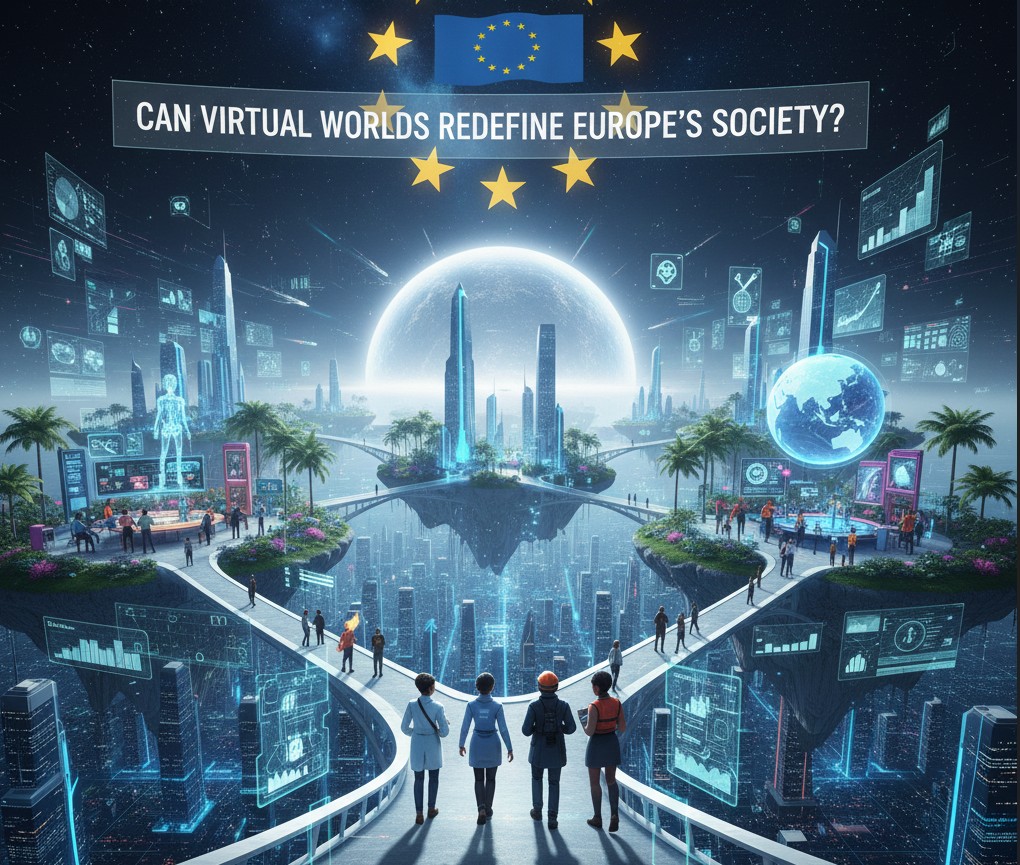
A Closer Look at Virtual Worlds
Virtual worlds, also referred to as metaverses, are increasingly becoming the next layer of our digital lives: interactive online environments where people can move, communicate, create and experience activities in ways that feel both familiar and entirely new. The European Commission describes them as computer-simulated immersive environments that allow users to participate in everything from work meetings to cultural events, using digital identities that act as their presence in the virtual environment.
These worlds are built on a spectrum of technologies - some fully digital, like immersive virtual reality, others blending physical surroundings with digital layers, and many supported by advanced simulations that mirror real-world systems. While the underlying technology may differ, the concept remains the same: virtual worlds create places where individuals and organisations can interact as naturally as they would in person.
Today, these environments already appear in many forms, from expansive gaming universes to industrial platforms for testing production lines, from virtual classrooms to digital collaboration spaces for remote teams. What makes these environments distinct is their persistence, the ability for users to shape them actively, the sense of immersion they provide and the shared experiences they enable. In practice, virtual worlds are no longer abstract ideas - they are tools people use every day, whether working together in digital meeting rooms, exploring interactive educational environments or participating in large online spaces that bring millions of users together.
As Europe looks ahead, these worlds are expected to become an essential part of how citizens engage with digital services, learn new skills and connect.
Why Europe Cannot Ignore Virtual Worlds
As already mentioned, virtual worlds are emerging as the next layer of the internet, creating persistent and immersive environments where digital and physical realities increasingly converge. Their potential extends far beyond entertainment into areas central to Europe’s economic and social development. In healthcare, virtual environments will enable medical students and professionals to train in realistic simulations of emergencies and surgical procedures, helping reduce risks, improve diagnostic accuracy and strengthen patient safety. In the context of the green transition, three-dimensional models will enable the simulation of the effects of global warming, better understanding of environmental challenges, and testing of mitigation measures before applying them in the real world. These immersive environments will also support more efficient industrial processes, helping companies reduce waste of energy, materials and resources. Industrial forecasts are already pointing to substantial gains: according to one European car manufacturer, by 2025, industrial virtual worlds will reduce vehicle delivery times by sixty percent and will cut the carbon footprint of vehicle manufacturing by half.
Creative sectors will also undergo a profound transformation. Virtual worlds will offer new spaces for fashion, cultural heritage, music, visual arts and design, creating opportunities for audiences to experience museums, concerts or theatre performances as if they were physically present. In education, virtual environments will support a more experiential learning process, enabling students to understand complex topics more intuitively and engage with content in ways traditional classrooms cannot replicate.
These developments align with the rapid growth of the virtual-worlds market. In 2022, the global market stood at 27 billion euros, with nearly 2 billion euros attributed to the automotive segment and more than 3,700 organisations in Europe operating in this domain. By 2030, the global market is expected to reach 800 billion euros, with the automotive segment projected to grow to more than 16 billion euros, creating hundreds of new jobs in this area. Recognising this transformative potential, the European Commission adopted its strategy on Web 4.0 and virtual worlds in 2023, aiming to ensure that Europe enters this technological transition with a clear vision and strong values. Virtual worlds are seen as a cornerstone of Web 4.0, a stage in which digital and real-world objects will interact seamlessly, enabling fully immersive services and experiences. The strategy is built on four pillars:
- empowering people and reinforcing skills, to foster awareness, ensure access to trustworthy information and build a talent pool of virtual-world specialists;
- government, by supporting societal progress and virtual public services to leverage the opportunities virtual worlds can offer;
- business, by supporting a European Web 4.0 industrial ecosystem to scale up excellence and address fragmentation;
- governance, by establishing the structures needed for the European Union to guide and safeguard the openness of virtual worlds.
These priorities directly support the objectives of the European Union’s Digital Decade, which we already discussed in our September article. The Digital Decade sets ambitious goals for skills development, digital public services, secure infrastructures and the digital transformation of businesses by 2030. Virtual worlds will play a critical role in advancing these targets by strengthening innovation capacities, improving public service delivery and reinforcing Europe’s technological sovereignty.
For Europe, the question is no longer whether virtual worlds will matter - it is how quickly they will reshape its economy and society, and how effectively European organisations will position themselves to lead this transformation.
Virtual Worlds, Real Business Potential
Virtual worlds offer a wide range of opportunities for European businesses and innovators, particularly for small and medium-sized enterprises that are agile enough to explore emerging technologies early.
As we highlighted in the previous chapter, the potential of virtual worlds extends across industry, healthcare, education, tourism, culture and the creative sectors. Their cross-sector impact makes them one of the most promising areas for innovation and growth in the coming years.
To support these developments, the European Union has introduced a broad range of funding channels, including Horizon Europe, the Digital Europe Programme, Creative Europe and various cascade funding mechanisms that provide fast and accessible financial support.
These instruments are designed to help organisations experiment with virtual-world applications, build prototypes, develop digital skills and bring innovative solutions to the market. A broad spectrum of actors can apply, from startups and universities to public institutions, but small and medium-sized enterprises are particularly well positioned to benefit. With lower entry barriers, targeted funding schemes and the ability to move quickly, SMEs can use virtual worlds to explore new markets, differentiate their services and strengthen their competitiveness within Europe’s rapidly evolving digital landscape.
One of the key opportunities emerging within this landscape is the upcoming Digital Europe Programme: Virtual Worlds Test Beds call (submission in March 2026). This initiative will establish two large-scale test beds - one for industrial applications and one for societal domains - bringing together networks of physical and virtual facilities across several European countries. Through these test beds, organisations will be able to validate advanced virtual-world technologies in real operational environments, integrate XR, AI, IoT and digital-twin solutions, and address interoperability, regulatory and user-centric aspects early in development. For companies considering deeper involvement in virtual-world innovation, this call offers a meaningful pathway to scale their ideas within a structured European framework. Those interested in exploring this opportunity are welcome to get in touch with Tiko Pro for further guidance.
Looking Toward the Future
As we have seen throughout this article, virtual worlds are becoming a key element of Europe’s digital future. With a clear European strategy, a rapidly expanding market and strong opportunities for businesses of all sizes, virtual worlds are set to play an important role in the next technological chapter.
And as December invites us to pause, reflect and celebrate what we have achieved, it also marks the moment to look ahead with curiosity and ambition. At Tiko Pro, we remain committed to helping organisations transform their innovative ideas into funded projects, guiding them through opportunities that support real growth and impact. We look forward to new adventures, new partnerships and new topics that will shape the year ahead. The future will bring many possibilities - and we are excited to explore them together.