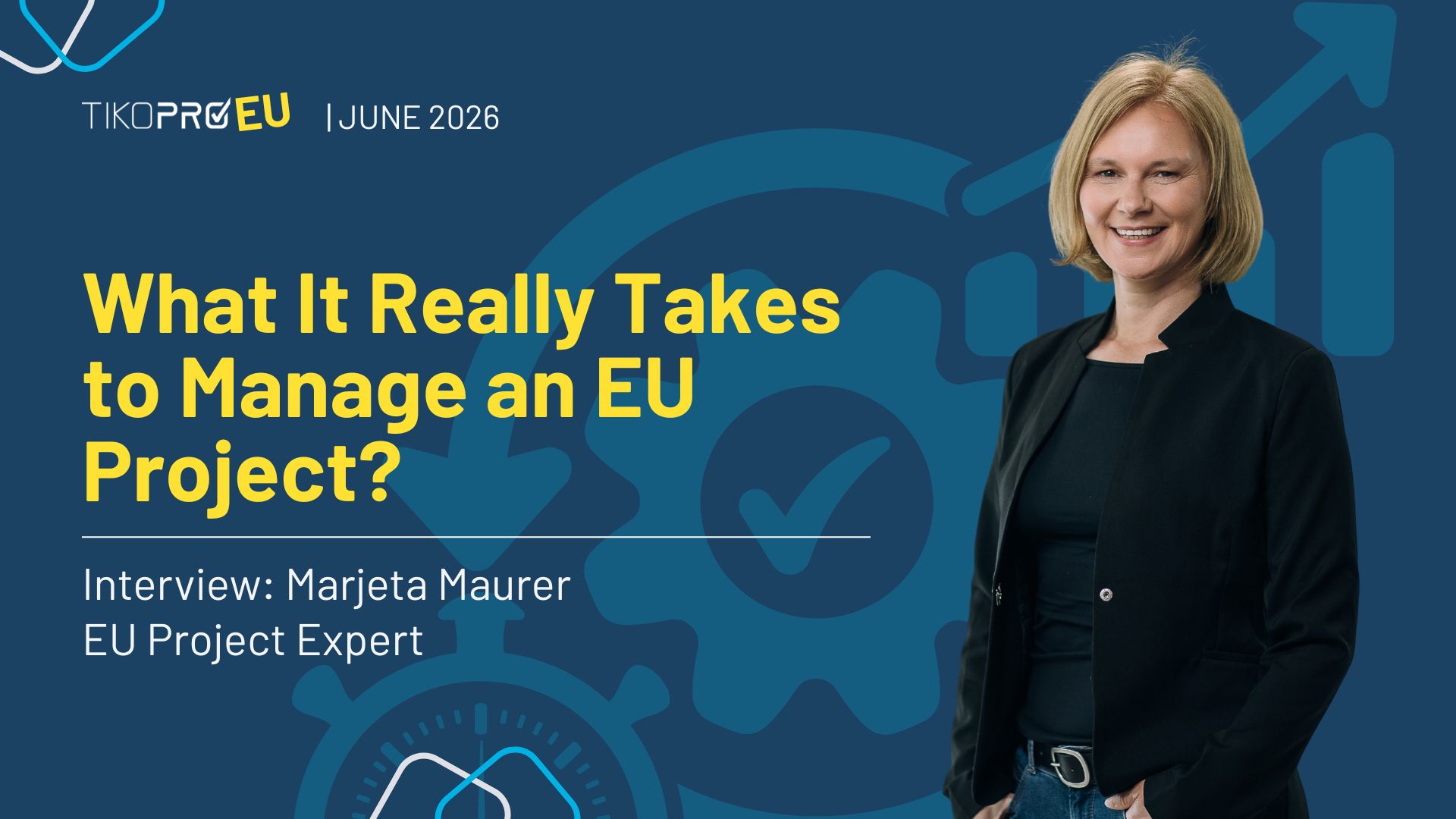
An interview with Marjeta Maurer about the realities of managing European projects after funding approval and the key challenges organisations face during implementation.
Securing European funding is often seen as the finish line. In reality, it is only the beginning of a much more demanding journey. Once a project is approved, organisations enter a complex environment of financial management, reporting obligations, consortium coordination, strategic decision-making, and continuous communication with the European Commission and project partners.
In this edition of the Tiko Pro newsletter, we spoke with Marjeta Maurer, EU Project Expert at Tiko Pro, about what truly happens after a company receives the long-awaited approval. Through this conversation, we explored the realities of project management in European projects - from allocating budgets and managing risks, to overcoming unexpected challenges and ensuring that projects deliver long-term value beyond the funding period itself.
When companies think about EU funding, most attention is usually placed on the application phase. But what actually happens once the project is approved?
That is very true. Most organisations invest enormous amounts of energy into preparing a strong proposal, building the consortium, defining the work packages, and aligning everything with the expectations of the call. However, once the project is approved, a completely different phase begins - and in many ways, that is where the real challenge starts.
At that point, companies are no longer selling an idea. They are expected to execute it. This means transforming the proposal into operational activities, setting up internal management structures, aligning partners, organising reporting systems, monitoring deliverables, and ensuring that every activity remains compliant with the contractual obligations defined by the European Commission.
Many organisations underestimate how demanding this transition can be. European projects are not only innovation projects - they are also management projects, financial projects, and communication projects at the same time.
You mentioned compliance and financial management. From your experience, what are some of the biggest mistakes organisations make at the beginning of a project?
A common mistake is assuming that the approved budget can be adjusted informally during implementation. EU project budgets do allow a certain level of flexibility, but this flexibility must be justified, traceable, and aligned with the approved project objectives. Organisations should monitor spending from the start, especially across cost categories, work packages, partners, and reporting periods. Good financial management is not about rigidly following every initial estimate, but about ensuring that any changes remain compliant and support the project logic.
Another issue is that some organisations start focusing exclusively on technical implementation while neglecting management and coordination processes. But without strong project governance, even technically excellent projects can run into serious difficulties later on.
It is also very important to establish clear communication channels inside the consortium early. Delays often happen not because partners lack expertise, but because responsibilities are unclear, reporting is inconsistent, or decisions are not made quickly enough.
That connects well with the idea that EU projects are highly collaborative environments. What usually becomes the biggest challenge when many partners are involved?
Coordination. Without a doubt. European projects often bring together organisations from different countries, sectors, and organisational cultures. Each partner has different priorities, capacities, and ways of working. Keeping everyone aligned over several years requires continuous communication and a very structured management approach.
Another important aspect is expectation management. Sometimes partners enter a project with different interpretations of their role or different assumptions about timelines and outcomes. If those expectations are not aligned early, tensions can appear later during implementation.
This is why project management in EU projects is not only administrative work. It is also about diplomacy, strategic coordination, stakeholder management, and the ability to keep the consortium moving toward shared objectives even when unexpected situations arise.
Speaking of unexpected situations - what can realistically go wrong during a European project?
A lot of things can happen, especially in projects that run for three or four years.
Partners can experience organisational changes, key employees may leave, technical development can take longer than expected, market conditions can shift, or regulatory frameworks can evolve during the project lifetime. In some cases, planned activities simply do not produce the expected results and the consortium needs to adapt quickly.
Financially, problems usually emerge when organisations fail to track costs properly or underestimate the importance of documentation. Even eligible activities can become problematic if they are not sufficiently justified or supported during reviews and audits.
Another challenge is maintaining momentum. Many projects start with high energy, but sustaining engagement across all partners throughout the entire project duration requires continuous coordination and strong leadership.
Looking at the broader picture, what separates successful EU projects from those that struggle?
The successful ones usually understand from the beginning that EU projects are long-term strategic commitments.
They allocate enough internal resources, involve management structures early, maintain realistic planning, and understand that flexibility is necessary throughout implementation. They also recognise that project management is not only about administration, but about actively steering the project toward measurable impact.
Most importantly, successful organisations treat the project as more than an isolated funding opportunity. They use it to build partnerships, strengthen their expertise, improve visibility, and position themselves for future initiatives.
Finally, what advice would you give to organisations that are about to start their first European project?
My advice would be simple: prepare for implementation with the same seriousness as you prepare the proposal itself.
A successful proposal opens the door, but strong project management is what ultimately determines whether the project will deliver meaningful results. Build clear internal structures, communicate continuously, document everything carefully, and never underestimate the importance of coordination.
European projects can create enormous opportunities for growth, innovation, and international collaboration - but only when they are managed strategically from the very beginning.
As our conversation with Marjeta highlights, successful European projects require much more than a strong proposal. Effective project management, financial oversight, coordination, reporting, and communication all play a crucial role in transforming approved ideas into measurable results.
At Tiko Pro, we support organisations throughout the entire project lifecycle - from identifying funding opportunities and proposal preparation to project implementation and long-term impact creation. Our expertise includes reporting support, consulting, technical assistance, consortium building, as well as communication and dissemination activities that help projects achieve visibility.
If your organisation is looking for support in any of these areas, feel free to contact us and explore how we can help turn your project idea into a successful European story.