Discover how leadership mindset, strategic vision, and international collaboration enable companies to turn European project opportunities into long-term growth, innovation, and competitive advantage.
What sets companies that successfully participate in European projects apart from those that, despite having excellent ideas, never achieve a breakthrough? The answer often lies in the mindset of their leadership.
We spoke with Kristina Kočet Hudrap, Founder and CEO of Tiko Pro, who has spent more than 15 years helping companies, research organisations, and public institutions secure European funding, build international partnerships, and develop innovative projects.
Drawing on her extensive experience within the European innovation ecosystem, she has guided numerous organisations from their first project idea to successful participation in international consortia. In this interview, she shares the qualities that distinguish leaders who recognise European opportunities, explains why strategic thinking matters more than a perfect proposal, and highlights how leadership can drive innovation, international collaboration, and long-term business growth.
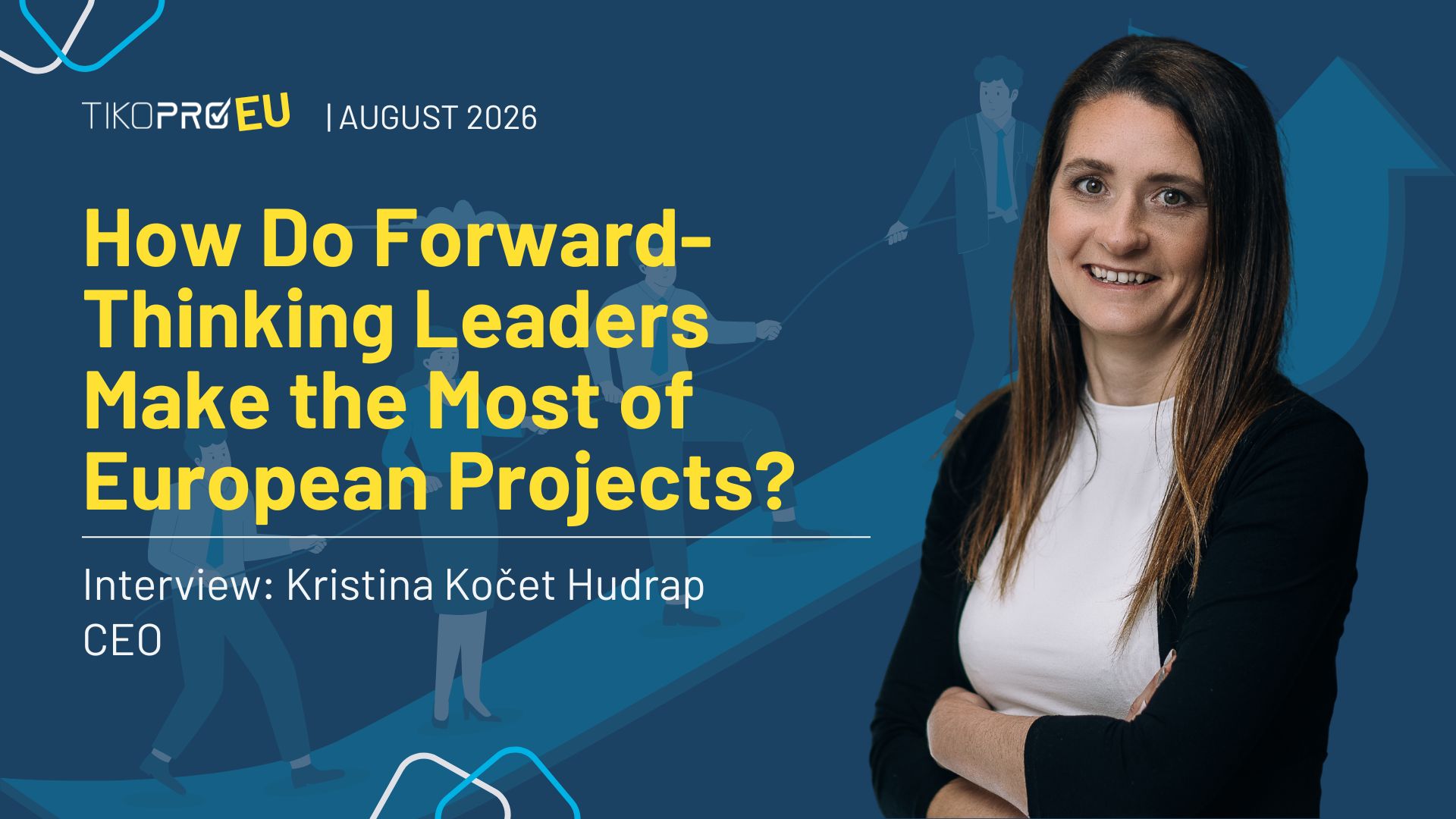 You have been leading Tiko Pro for more than 15 years. Today, the company operates successfully across the European market, connects organisations from different countries, and contributes to numerous European projects. What was your vision when you founded the company, and how has it evolved over the years?
When I founded Tiko Pro more than 15 years ago, my vision was to help organisations turn development ideas into reality and open the door to new opportunities. I believed that Slovenian companies had enormous potential but often lacked the confidence to expand into international markets.
Over time, we evolved from a consultancy focused on funding applications into a strategic partner that supports organisations from the earliest stages of idea development, partner identification, and the creation of projects with long-term impact. Today, we participate in European consortia in fields such as digitalisation, healthcare, and cybersecurity.
One of the most important lessons I have learned is that success depends not only on a good idea or the right funding call, but on leadership's ability to recognise opportunities, adapt to change, and think beyond immediate challenges. This mindset is what enabled us to establish a strong presence in the international arena.
In your previous answer, you mentioned leadership mindset. In your opinion, what distinguishes leaders who successfully seize opportunities offered by European projects from those who never pursue them?
The biggest difference lies in how leadership perceives European projects. We still frequently encounter the misconception that they are simply a source of "free money." In reality, European funding programmes are not designed to finance day-to-day business operations. Their purpose is to support breakthrough ideas, innovation, and solutions that create broader economic and societal impact.
Successful leaders do not see European projects as the end goal, but as a strategic tool for achieving their company's long-term ambitions. Rather than asking which funding call is currently open, they ask what vision they have for their company and how European projects can help them realise that vision more effectively.
Another defining characteristic is a willingness to collaborate. European projects are built on partnerships, knowledge exchange, and the joint development of solutions. Leaders with an open mindset are not afraid to work with research organisations, companies, and partners from other countries because they understand that true breakthroughs are often achieved through collaboration.
What qualities do you most often observe in directors and executives who are the most successful in European projects?
If I had to highlight one quality, it would be an inner drive - that feeling that constantly pushes you forward and never lets you settle for the status quo. These leaders do not wait for opportunities to appear. They actively seek them out and create them. Without that drive, long-term success is difficult to achieve, regardless of knowledge or strategy.
Curiosity and responsiveness are equally important. The European innovation landscape evolves rapidly, and successful leaders continuously monitor emerging trends, technologies, and development priorities. They are not afraid to ask questions, explore new fields, or challenge established ways of thinking. At the same time, they know when to act quickly because they understand that delayed decisions often mean missed opportunities.
Another common characteristic is long-term thinking. They do not view European projects as one-off funding opportunities but as a way to build new capabilities, strengthen international partnerships, and create sustainable competitive advantages for their organisations.
Based on your experience, how does a company change after participating in its first European project?
In my experience, a company's first European project brings much more than a valuable reference. It fundamentally changes the way the organisation thinks. Companies begin to see development, collaboration, and international opportunities from a completely different perspective.
Tiko Pro followed a similar path. In the beginning, we operated primarily in the Slovenian market. Gradually, we built an international network of partners, explored new opportunities, and became actively involved in European consortia. Today, we work with organisations across Europe, support companies in developing European projects, and in recent years have established ourselves as a trusted communication and dissemination partner in international projects.
This kind of transformation does not happen overnight. It is the result of an outstanding team of experts, but also of leadership that recognises opportunities, has the agility to pursue them, and possesses the courage to make strategic decisions.
Participating in European projects offers far more than access to funding. It creates new business opportunities, enables collaboration with leading international partners, accelerates knowledge transfer and capability development, strengthens market visibility, and lays the foundations for long-term growth and job creation. That is why I see European projects as a strategic investment in the future rather than simply another project.
If you could give business leaders just one piece of advice before they embark on their European project journey, what would it be?
Do not wait until your idea is perfect or until you have all the answers. The organisations that benefit the most are those willing to take the first step, build partnerships, and think long-term.
European projects are not reserved for large organisations or those with decades of experience. They are open to anyone with a clear vision, a commitment to growth, and the courage to test their ideas in an international environment. Success rarely happens overnight, but it is built through persistence, openness to collaboration, and a willingness to learn continuously.
Leadership plays a decisive role in this process. When leaders believe in development, encourage innovation, and recognise opportunities, that mindset spreads throughout the organisation. These are the companies that most often become successful partners in European projects and contribute to solutions that extend far beyond the boundaries of a single organisation or country.
This interview with Kristina Kočet Hudrap clearly demonstrates that success in European projects depends on much more than understanding funding programmes or preparing a strong proposal. It begins much earlier - with the mindset of leadership. Organisations that recognise opportunities, think strategically, build international partnerships, and foster a culture of innovation are the ones that transform European projects into new business opportunities, sustainable growth, and long-term competitive advantage. Perhaps now is the right time for your organisation to take its first step - and Tiko Pro is ready to support you with its expertise and experience.