In short: The Innovation Fund is the EU’s largest programme for bringing innovative clean technologies to commercial scale. It suits technologies that are mature enough for investment (in practice TRL 7–9). Its 2026 round (IF26) is planned to open in December 2026 with five routes: three grant calls (Net-Zero Technologies, SMEs and Maritime) and two auctions (industrial Heat and Hydrogen). The first deadlines fall in February 2027.
What is the Innovation Fund?
The Innovation Fund invests the revenues of the EU Emissions Trading System (EU ETS), the EU carbon market, in projects that cut greenhouse gas emissions. Put simply, polluters pay for a carbon price, and part of that money funds clean technology. The Fund is expected to provide about €40 billion in 2020–2030 (at a carbon price of €75 per tonne of CO₂).
It supports projects in two ways:
- Grants cover up to 60% of a project’s relevant costs: capital and operating costs minus operating revenues over the first ten years. Proposals are scored by independent evaluators on quality.
- Auctions pay a fixed premium for each unit of output, such as each tonne of CO₂ avoided or each kilogram of hydrogen produced. Projects that pass the minimum requirements are ranked by price, and the lowest bids win.
The Fund is growing in importance. According to the Commission’s 2026 Climate Action Progress Report and Carbon Market Report, EU emissions continue to fall, and an increasing amount of ETS revenues is available for investment in decarbonisation. The Clean Industrial Deal commits to strengthening the Fund and proposes an Industrial Decarbonisation Bank aiming for €100 billion, partly drawn from Innovation Fund resources. Demand is high: the 2025 Net-Zero Technologies call attracted 358 applications requesting €17.5 billion, six times its €2.9 billion budget.
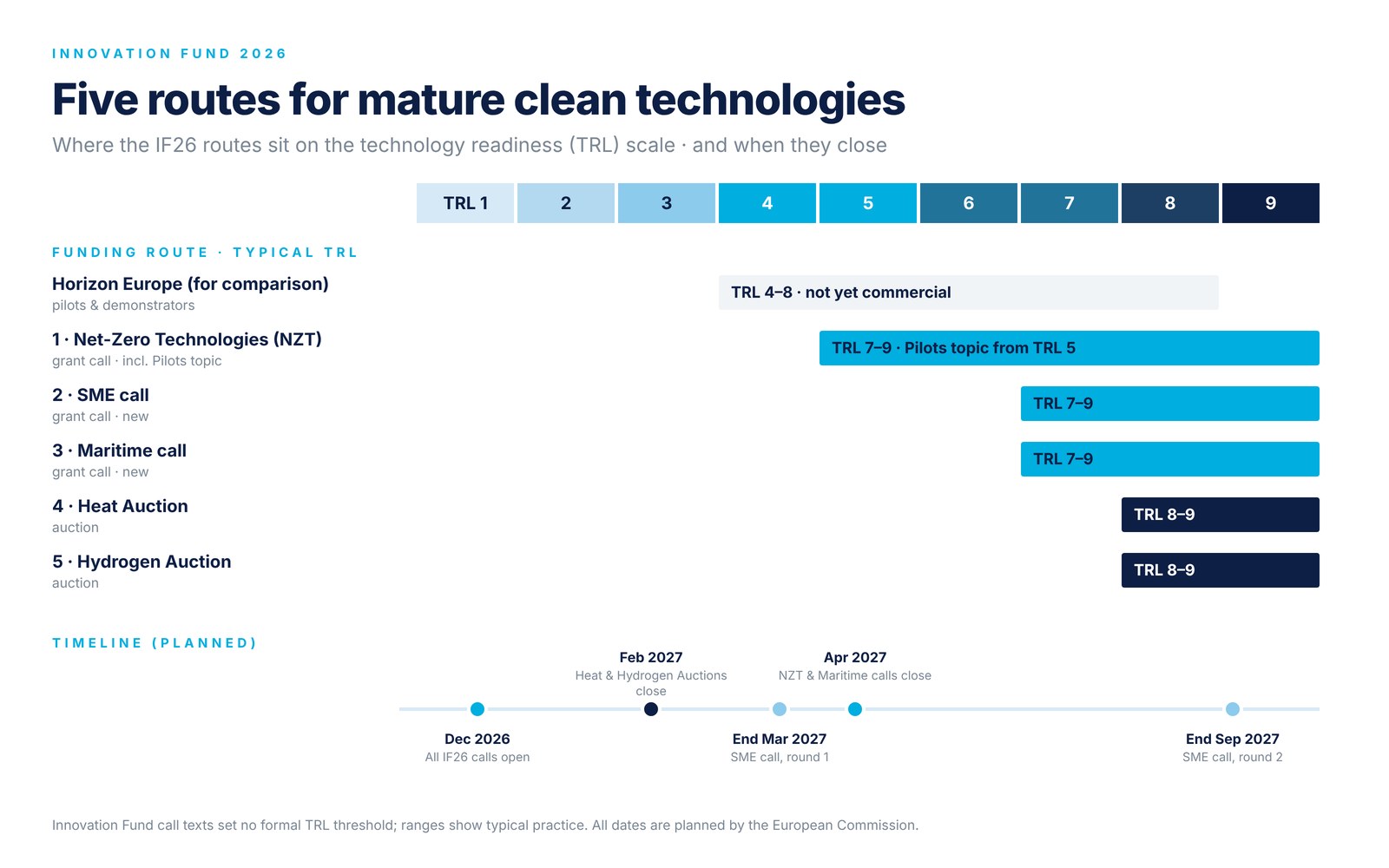
Figure: Innovation Fund 2026 – where the five IF26 routes sit on the TRL scale and when they close.
The five IF26 routes at a glance
The Commission plans to open all IF26 calls in December 2026. Each route serves a different type of project and applicant.
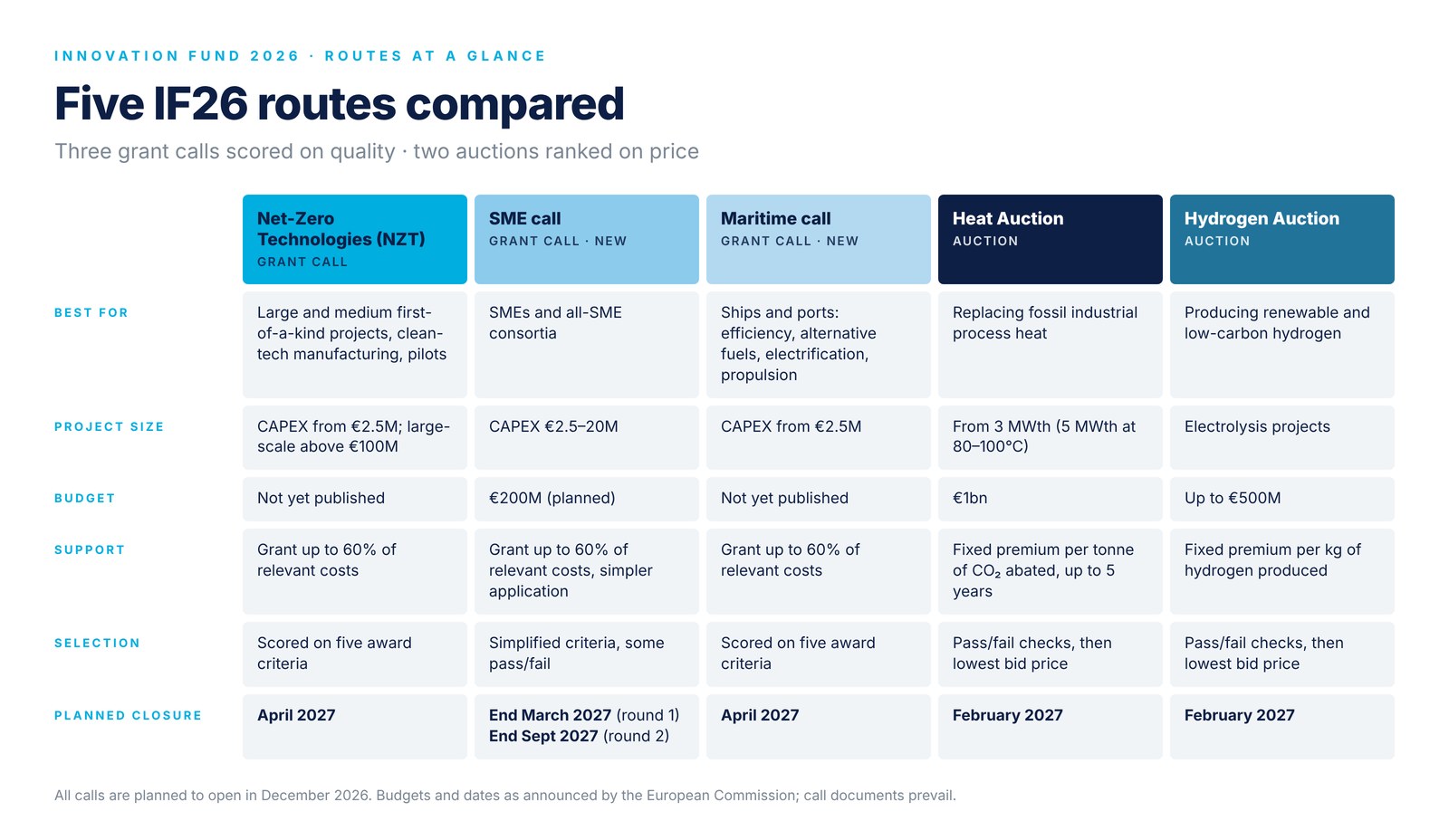
Figure: The five IF26 routes compared: three grant calls and two auctions.
Grant calls: scored on quality
1. Net-Zero Technologies (NZT) call
The IF26 Net-Zero Technologies (NZT) call is the Fund’s main grant call for industry. It is planned to open in December 2026 and close in April 2027, and its budget is not yet published. It has four topics:
- General decarbonisation, large-scale: CAPEX above €100M
- General decarbonisation, small and medium-scale: CAPEX €2.5–100M
- Clean-tech manufacturing and critical raw materials: components for renewables, energy storage, heat pumps and hydrogen production, CAPEX above €2.5M
- Pilots for deep decarbonisation: CAPEX above €2.5M
Evaluators score NZT proposals on five criteria: degree of innovation, greenhouse gas emission avoidance, project maturity, replicability and cost efficiency. They expect a feasibility study, a business plan, a detailed financial model and a GHG calculation whose figures are consistent with each other.
2. SME call (new)
The new IF26 SME call, with a planned €200 million, is reserved for small and medium-sized enterprises and consortia made up only of SMEs. It targets projects with CAPEX of €2.5–20 million. The application is simpler: fewer documents, a semi-automated tool for calculating greenhouse gas avoidance and lighter reporting. The call has two rounds, closing at the end of March 2027 and the end of September 2027.
3. Maritime call (new)
The new IF26 Maritime call funds first-of-a-kind low- and zero-carbon technologies for ships and ports: energy efficiency, sustainable alternative fuels, electrification, zero-emission and wind-assisted propulsion, and innovative port infrastructure. Projects need CAPEX of at least €2.5 million and are scored on the same five criteria as NZT. The call is planned to close in April 2027. Maritime projects can no longer apply under NZT unless they are pilots.
Auctions: ranked on price
4. Heat Auction: paid per tonne of CO₂ abated
Industrial process heat, still largely powered by fossil fuels, represents three-quarters of industrial emissions. The IF26 Heat Auction (€1 billion) targets it directly. It opens in early December 2026 and is planned to close in February 2027. Winners receive a fixed premium per tonne of direct CO₂ emissions avoided, for up to five years after the plant starts operating.
Projects must replace fossil heat with new electrified, direct renewable or nuclear heat capacity. The final Terms and Conditions split the budget by the temperature of the heat a plant needs:
- Low temperature, 80–100°C (€100M): projects of at least 5 MWth using heat pumps (COP above 1.5), direct renewable heat or nuclear heat
- Medium temperature, 100–400°C (€600M): projects of at least 3 MWth
- High temperature, above 400°C (€300M): projects of at least 3 MWth, with no upper temperature limit
The selection process is simple, but competition is fierce. Once projects meet the minimum requirements, they compete solely on bid price in € per tonne of CO₂. Winners receive exactly what they bid. Some technologies get a 25% bonus that lowers their bid price for ranking: heat pumps with a coefficient of performance (COP) of at least 1.5, which means they deliver at least 1.5 units of heat for every unit of electricity; thermal or electricity storage; and direct renewable or nuclear heat. Bids are capped at €400/tCO₂ for low and medium temperatures and €800/tCO₂ for high temperatures. Winners must provide a completion guarantee of 6% of the grant, backed by a bank letter of intent at submission.
Compared with the first heat auction in 2025, the IF26 Heat Auction opens to heat from 80°C instead of 100°C, and nuclear heat, such as small modular reactors, is eligible for the first time. The Commission calls this auction “a crucial stepping stone toward the implementation of the Industrial Decarbonisation Bank.”
5. Hydrogen Auction: paid per kilogram of hydrogen
The IF26 Hydrogen Auction is the fourth auction of the European Hydrogen Bank, with up to €500 million. It opens in December 2026 and is planned to close in February 2027. Winners receive a fixed premium for each kilogram of hydrogen produced. The draft design has two topics: €350 million for renewable hydrogen (RFNBO) and €150 million for renewable and/or low-carbon hydrogen produced by electrolysis.
In both auctions, Member States can add national budgets to fund more projects on their territory through Auctions-as-a-Service.
Which route fits your project?
Start from the type of project, then check its size and maturity:
- Replacing fossil process heat in your plant → Heat Auction, if you can offer a competitive price per tonne of CO₂; NZT, if your solution is innovative enough to score well on quality.
- Producing renewable or low-carbon hydrogen → Hydrogen Auction.
- A ship or port project → Maritime call.
- An SME with a project of €2.5–20 million → SME call.
- Any other first-of-a-kind decarbonisation or clean-tech manufacturing project → NZT call.
The grant calls reward the strongest overall case, including innovation beyond the state of the art. The auctions reward the lowest cost.
Not ready for investment yet? Horizon Europe is your route
The Innovation Fund call texts set no formal TRL threshold. They ask for technologies that are sufficiently mature for commercial deployment, and for pilots that run in real operating conditions before full-scale deployment. If your technology still needs validation at pilot scale or a first demonstration in an industrial setting (around TRL 4–8), Horizon Europe is the better route.
In 2027, three Horizon Europe calls target energy-intensive industry:
A successful Horizon Europe demonstrator is often the step before an Innovation Fund application. Read more in our article Decarbonising your plant: which EU calls fit your next step in 2027?
What this means for applicants
Three signals stand out. First, each type of route has its own winning logic. In the auctions, price beats prose: a credible CO₂ baseline, an electricity sourcing strategy and a realistic bid decide. In the grant calls, evaluators score the whole case, so innovation, emission savings and cost efficiency must hold together. Second, maturity must be proven, not described: off-take, grid connection, procurement, financing and permits need evidence, and the auctions’ completion guarantee makes overpromising expensive. Third, time is short: the Heat and Hydrogen Auctions close in February 2027, about ten weeks after opening in December 2026, and the NZT and Maritime calls close in April 2027, about four months after opening. The technical and financial groundwork must start now.
Proposals fail when strong technology is not backed by a bankable business case. The winning narrative quantifies impact: tonnes of CO₂ avoided, cost per tonne and a firm date for entry into operation.
These calls also preview what comes next. The Industrial Decarbonisation Bank will build on Innovation Fund resources, so projects prepared for IF26 are positioned for the next wave of EU decarbonisation funding.
How Tiko Pro supports applicants
We support the whole journey, from the first viability check to project delivery. We start by assessing which route fits your investment, testing the CO₂ baseline and economics, and giving you a clear GO or NO-GO decision before you commit resources.
Proposal preparation. We prepare the full proposal package, structured for each type of route:
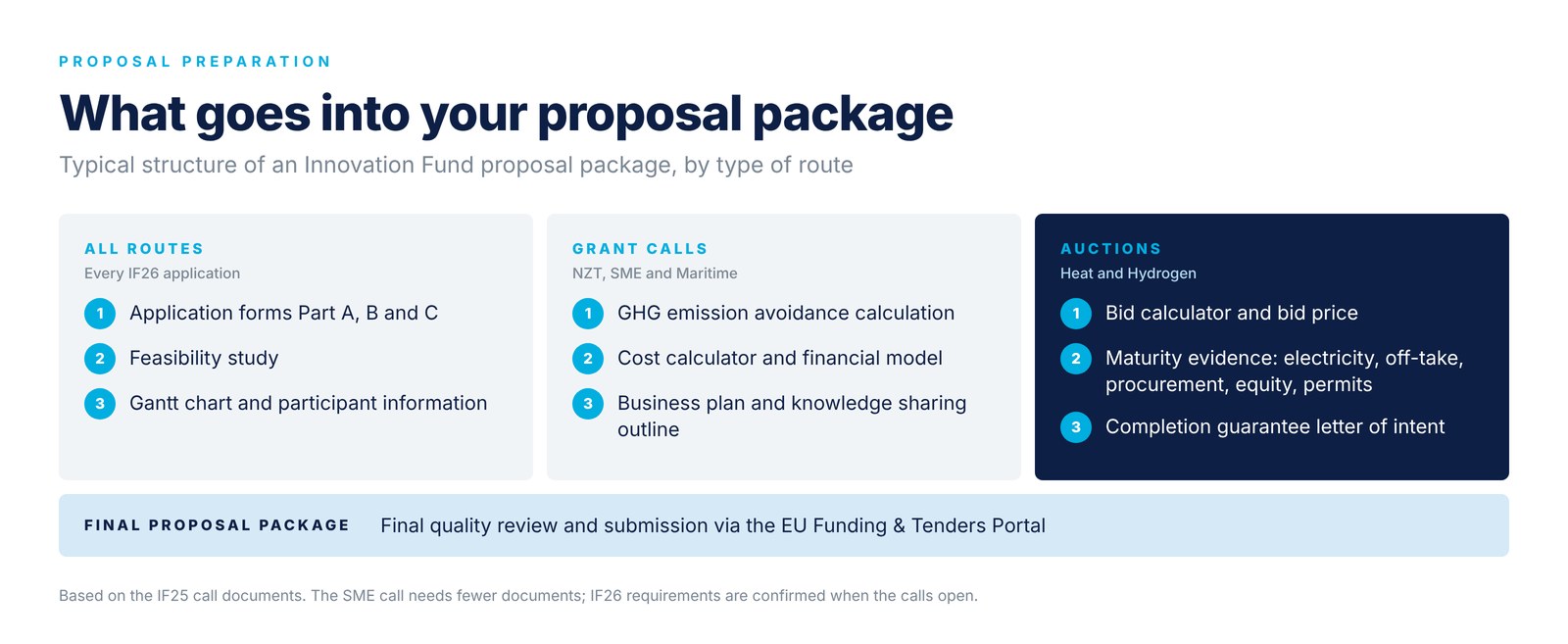
Figure: What goes into your Innovation Fund proposal package, by type of route.
After submission and award. Our support continues through grant preparation and project delivery:
- Evaluation: we coordinate clarification responses where the procedure allows, while your team maintains readiness.
- Grant preparation: if selected, we support the grant agreement package and agreed milestones, including the completion guarantee for auction projects.
- Project delivery: we support management, reporting and payment requests. Grant payments follow agreed milestones; auction payments follow verified output during operation.
With the first IF26 deadlines in February 2027, now is the time to start.
Contact our team to discuss your project idea