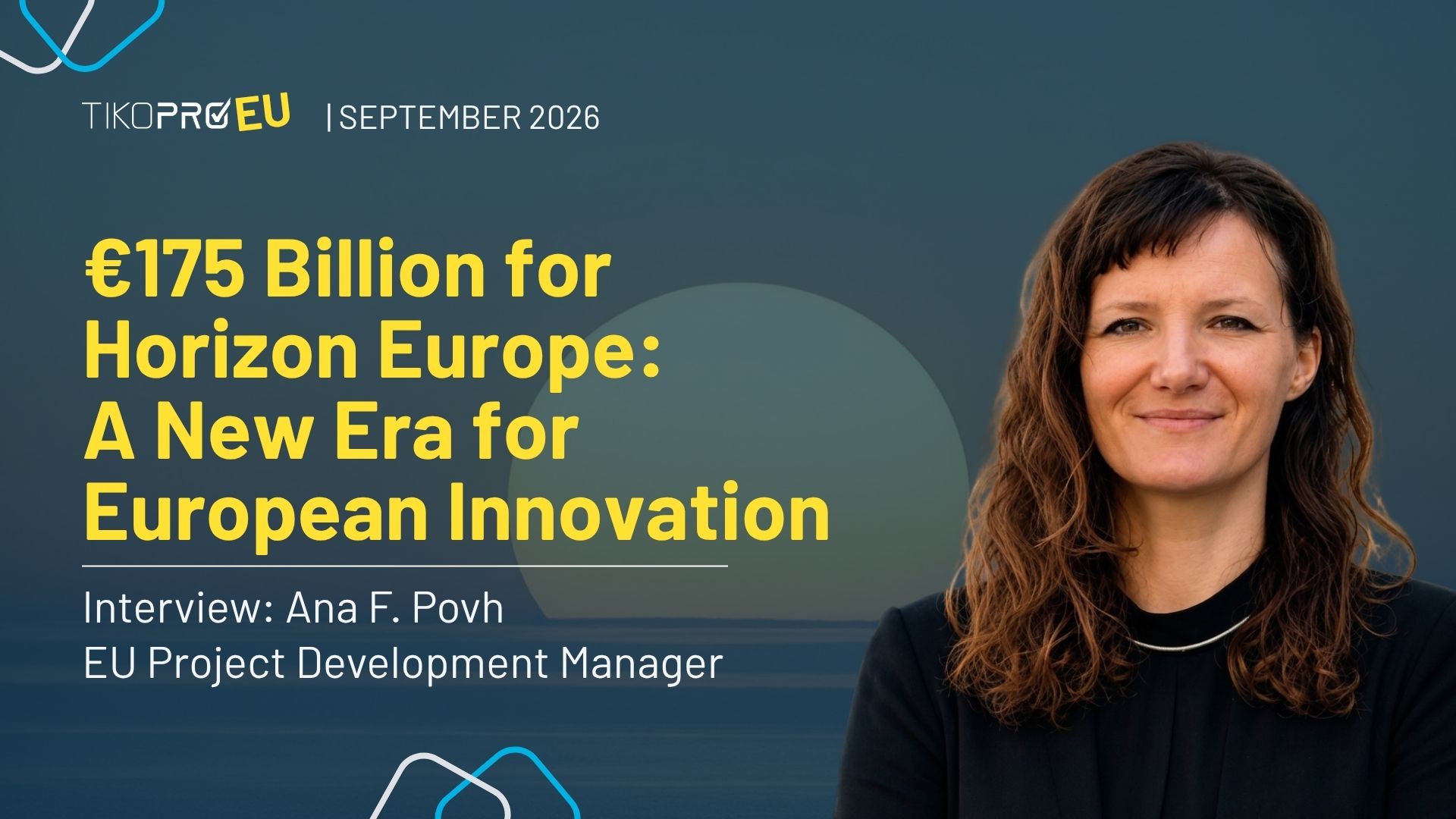
We sat down with Ana F. Povh, EU Project Development Manager at Tiko Pro, to discuss what the next generation of Horizon Europe could bring.
Europe is preparing for a new chapter in research and innovation funding. With ambitious Research and Development (R&D) budget proposals for the period after 2027, including a significantly larger budget, simpler procedures and a stronger focus on competitiveness and impact, the next generation of EU funding programmes could bring important changes for European companies.
But what do these changes actually mean in practice? And what should companies be doing today to prepare for the opportunities ahead?
We discussed this with Ana F. Povh, EU Project Development Manager at Tiko Pro. Ana brings nearly 10 years of hands-on experience from Austria in successful proposal writing, EU project management, intellectual property management and consortium building, backed by a master’s degree in technology law and academic work on Horizon Europe in collaboration with MCI Innsbruck.
In this interview, Ana shares her perspective on the direction EU funding is taking, what the proposed changes could mean for organisations applying to Horizon Europe calls and how they can position themselves for the next EU funding period.
 Ana, there is a lot of discussion about the future of EU R&D funding after 2027. Are we really entering a new era?
I think we can definitely say that we are moving towards a new chapter. The European Commission’s proposals for 2028 to 2034 show a clear ambition to make research and innovation an even stronger driver of Europe’s competitiveness. It is not only about more funding. Europe wants to invest more strategically and create a clearer path from research and innovation to real market impact. Of course, many details are still being shaped, but the direction is clear. For companies, this means significant opportunities, but also a stronger need to connect their innovations with Europe’s economic and strategic priorities.
One of the biggest announcements is the proposed €175 billion budget for the next Horizon Europe programme. What does this tell us about Europe’s ambitions for research and innovation?
The proposed €175 billion budget is certainly a strong signal, especially as it is almost twice the size of the current programme. But what matters even more is what Europe wants to achieve with this investment.
Europe has excellent research and innovation potential, but we do not always succeed in turning it into technologies and companies that can compete globally. This challenge was also highlighted in Mario Draghi’s report on European competitiveness, which identified closing Europe’s innovation gap and improving the ability to commercialise and scale innovation as key priorities for future growth.
The next programme aims to address this gap by creating stronger links between research, innovation and economic growth. For innovative companies, this could open up significant new opportunities.
Beyond a bigger budget, the European Commission is promising a simpler and faster programme. What could actually change for companies applying for EU funding?
This could be one of the most important changes for applicants. Applying for European funding can be demanding, especially for companies with limited experience or resources.
The Commission is proposing fewer topics, shorter and more accessible work programmes, simpler application processes and faster access to funding. If implemented effectively, these changes could make EU funding much easier to navigate. However, simpler does not necessarily mean easier to win. Greater accessibility could also attract more applicants, so strong project positioning and proposal quality will remain essential.
Looking at the proposed priorities, which areas are expected to receive the strongest attention in the next funding period?
The direction is already becoming quite visible. The Commission is putting strong emphasis on areas that are considered critical for Europe’s future competitiveness and strategic autonomy.
These include clean transition and industrial decarbonisation, health and biotech, digital technologies, as well as security, defence and space. We also see very ambitious technology driven areas emerging, such as next generation AI, quantum computing, automated mobility, regenerative therapies and fusion energy.
For companies, this is useful information because it shows where Europe wants to build technological leadership. It does not mean that every project needs to be in deep tech, but companies should understand how their innovation connects to these wider priorities.
Competitiveness, scaling and bringing innovations to market are becoming increasingly important. What does this shift mean for companies?
The Technology Readiness Level, or TRL, approach remains relevant. Projects will still enter European funding programmes at different stages of maturity, from early research to demonstration and solutions that are much closer to the market.
What is changing is the emphasis on what happens next. Europe increasingly wants to ensure that promising research and technologies do not stop when a funded project ends, but have a realistic pathway towards further development, deployment, scaling and market uptake.
This means companies should think beyond the project itself. Even when a project focuses on lower TRLs, it is important to understand where the technology could go afterwards, who could use it and what further steps would be needed to bring it closer to real-world application.
The stronger connection between Horizon Europe and the European Competitiveness Fund reflects this direction. The goal is to create a more continuous journey from research to innovation and ultimately to solutions that can strengthen Europe’s competitiveness.
Is it too early for companies to start preparing for the next programme? What should they be thinking about already today?
Definitely not. The strongest European projects never begin when a call is published. They begin much earlier, with a clear understanding of where the company wants to go and what it wants to develop. Companies can already identify how their R&D activities connect with European priorities, build relationships with international partners and consider which ideas could develop into collaborative projects. The details of the new framework will continue to evolve, but companies that prepare early will be in a much stronger position when new opportunities become available.
With more funding and potentially more opportunities also comes more competition in applying. How can companies position themselves for success at the relevant open call?
Applying for Horizon Europe has always been highly competitive. The key is to stand out among all the other submitted proposals, and this is where Tiko Pro can help. An innovative approach, cross-sectoral partnerships, a strong impact story and the intellectual property to be created are all of crucial importance. But not every consortium knows how to develop and present its project in a way that captures the evaluator’s attention from the very first page.
This is where years of hands-on experience makes a real difference. At Tiko Pro, we help companies and research organisations throughout this process, from identifying most suitable funding opportunities, developing the competitive project concept, building international consortia, leading the proposal preparation process that turns into highly competitive proposals.
As the funding landscape evolves, organisations that prepare early and approach EU funding strategically will be best positioned to turn these new opportunities into successful projects.
Our conversation with Ana shows that the next era of EU funding is already beginning to take shape, bringing new priorities and opportunities for European companies. And as Ana explained, when it comes to EU funding, there is no such thing as preparing too early. Companies that start developing the right ideas, building strong partnerships and aligning their ambitions with Europe’s future priorities today will be better positioned to turn tomorrow’s opportunities into successful projects and long-term growth.